It is required to make a quick remark on the Bulldog and the Terrier in order to accurately describe the origin and history of the American Staffordshire Terrier.
The Bulldog was carefully bred in England up to the early 19th century with the intention of baiting bulls. The Bulldog of that time was quite unlike from the British Bulldog of today. The Bulldog is shown in images dating back to 1870 as being nimble and standing upright on his legs, particularly his front legs. Long rat tails weren’t unusual, and in rare instances, he even had a muzzle. With the exception of the head, the bulldog of that era resembled the American Staffordshire Terrier more than the British Bulldog of today.
Some authors claim that in order to improve the Staffordshire Terrier, the white English Terrier or the Black-and-Tan Terrier were crossed with the Bulldog. Given that some of the top experts on dogs of the era claim that the Black-and-Tan and the white English Terrier were neither very game nor the Fox Terrier particularly game, it is simpler to assume that any game terrier, such as the Fox Terrier of the early 1800s, was utilized in this cross. It seems sense to assume that breeders would not employ a terrier that wasn’t in the hunt if they were trying to develop a canine that would mix the enthusiasm and agility of the terrier with the bravery and tenacity of the Bulldog. The three terriers described above exhibit very minor variances in bodily conformation, with the most notable distinctions being in their color, level of aggression, and spirit.
The “Bull and Terrier” breeds were created in the early 1800s to meet the demands of pest control and animal-based blood sports. The Old English Bulldog (now extinct) and one or more Old English Terriers and “Black and Tan Terriers,” today known as Manchester Terriers, served as the basis for the “Bull and Terriers.” This new breed combined the agility and quickness of lean terriers with the stern determination of the Bulldog, a dog that performed poorly in most combat scenarios since it was almost exclusively developed for killing bulls and bears chained to posts. The “Bull and Terrier” subsequently split into the ancestors of “Bull Terriers” and “Staffordshire Bull Terriers,” both smaller and more manageable than the progenitor, since there were no breed standards because breeding was done for performance rather than looks.
James Hinks of Birmingham began mating “Bull and Terriers” with “English White Terriers” (now extinct) in the 1860s in an effort to produce a cleaner-looking dog with better legs and a finer head. In the Bull Terrier Class of the dog show held at the Cremorne Gardens in Chelsea in 1862, Hinks submitted a bitch named “Puss” that was a daughter of his white Bulldog named “Madman” into the competition. These dogs, who were once referred to as the “Hinks Breed” and “The White Cavalier,” did not yet have the now-famous “egg face,” but they did maintain the halt in the skull profile.
In any case, the Staffordshire Terrier, also known as the Bull-and-Terrier Dog, Half and Half, Pit Dog, and Pit Builterrier, was created by crossing the Bulldog with the Terrier. Later, it adopted the moniker Staffordshire Bull Terrier in England.
As early as 1870, these canines started making their way to America, where they were given the names Pit Dog, Pit Bull Terrier, American Bull Terrier, and finally Yankee Terrier. All American Staffordshire Terriers have English and Irish ancestors in their pedigrees, particularly those brought here by John P. Colby.
The United Kennel Club (UKC), currently known as the American Pit Bull Terrier, was founded in 1898 with the specific purpose of establishing registration and fighting regulations for this breed. One of the creators, C. Z. Bennett, gave his own APBT, Bennett’s Ring, the UKC registration number 1 in 1898. Cross-breeding was once considered unacceptable. Later, people who wanted to dissociate themselves from the breed’s history of fighting petitioned the American Kennel Club (AKC) to recognize the American Pit Bull Terrier so that it would be permitted to compete in dog shows and other performance-based competitions. On June 10th, 1936, the AKC agreed, but only on the condition that the dogs registered with them be named “Staffordshire Terriers,” the name of the English area where the breed is said to have originated.
Many owners registered their dogs with both the AKC and the UKC when the breed was recognized. The first dual-registered American Pit Bull Terrier and Staffordshire Terrier was PR Lucenay’s Peter, the canine hero of the Our Gang television series. The AKC demanded a breed standard for this apparently brand-new breed. A commission led by Wilfred T. Brandon selected Colby’s Primo as the benchmark for the “Staffordshire Terrier” after visiting a few kennels. Primo, owned by Colby, was born on May 29, 1935. Colby’s Brandy was his father, and Colby’s Mable was his mother. Primo has registration numbers with the ADBA 500-01, the UKC 233-460, and the AKC 641-443.
As the UKC developed, it ultimately started registering other working-type breeds and held competitions like to those put on by the AKC. The UKC is now the second-largest purebred dog registration in the United States of America, and it has rigorous rules that prohibit anybody who has been found guilty of dog fighting from participating.
Because some dog lovers believed that the UKC was not doing enough to safeguard and maintain the American Pit Bull Terrier breed, the American Dog Breeders Association (ADBA) was established in 1909. The ADBA’s objective hasn’t changed since it was established: to register, promote, and conserve the original American Pit Bull Terrier fighting breed, often known as bulldogs and gamedogs. However, like the other two registries, the ADBA officially opposes dog fighting as being against the law.
The weight of an American Staffordshire Terrier may vary, but it must be proportionate to its size. The dog should have tremendous bravery, soundness, balance, a powerful head, a well-muscled body, and strength that is extraordinary for his size. A statement about the English Staffordshire Bull Terrier can be useful to dispel any ambiguity regarding the distinction between the American Staffordshire Terrier and the breed even among dog enthusiasts.
Beginning on January 1, 1972, the term “Staffordshire Terrier” was changed to “American Staffordshire Terrier.” The inclusion of the moniker “America” was intended to designate them as two distinct breeds since American breeders had created a kind that is bulkier than the Staffordshire Bull Terrier of England.
AKC finally banned American Pit Bull Terriers from its studbooks. Only pups whose parents were officially recognized as “Staffordshire Terriers” were permitted to register. The AKC briefly allowed American Pit Bull Terriers to reenter its studbooks in the 1970s. Currently, only pups with American Staffordshire Terrier parents may register. American Staffordshire Terriers may be registered with the ADBA and the UKC, however in both associations, the dogs are referred to as “American Pit Bull Terriers,” their original moniker.
In many American Staffordshire Terrier pedigrees, including those of numerous AKC Champions like Ch. Tuffie of Detroit, Ch. The Ruffian, Ch. Ruffian Out Teenie, Ch. Headlight Hal, Ch. Ruffian Walkaway, and Ch. Blueguard, Grand Champion Tudor’s Black Jack (16xw) is regarded as one of the foundation dogs.
Colby’s Pisncher, Colby’s Tige, Galvin’s Pup, Jack White’s Teddy, Armitage’s Kager, The Gas House Dog, Clark’s Jiggs, Corrington’s Dixie Lil, Tudor’s King, and others are well-known American Pit Bull Terriers that are included in many American Staffordshire Terrier pedigrees. Pit fighting champion Champion Tudor’s Black Demon was the great-grandson of AKC champion Ruffian Black Beauty of Harwyn.
Other than being a Bull and Terrier hybrid, the only other legitimately acknowledged history of the American Pit Bull Terrier and American Staffordshire Terrier is that they are genuine old original Bulldogs. Numerous artworks show these older, original Bulldogs as pure Bulldogs, with no Terrier cross-breeding. It is clear that they resemble American Pit Bull Terriers.
According to a different account of history, the old-time Bulldog’s ancestors were Spanish Alanos dogs. According to legend, the English brought several of these Spanish Bulldogs into the country after seeing how useful they were as working dogs.
Due to the potato famine, later immigrants from England and Ireland came to the United States of America and carried their dependable Bulldogs with them. Even though they could have first been mixed with the English White Terrier or Black and Tan Terrier, some people think that breeders kept the dogs pure and did not cross them with Terriers.
Many breeds, notably the Ca De Bou and the Cordoba Fighting dog employed as a component of the Dogo Argentino, are thought to have their origins in the Alano (or its forebears). Both claims could be accurate since some people mixed Spanish Bulldogs with other breeds while others did not. The Spanish Alano and the properly bred American Pit Bull Terrier are quite similar.
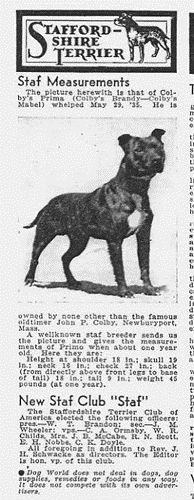
Primo, owned by Colby, was born on May 29, 1935, Colby’s Brandy was his father, and Colby’s Mable was his mother. Primo has registration numbers with the ADBA 500-01, the UKC 233-460, and the AKC 641-443.
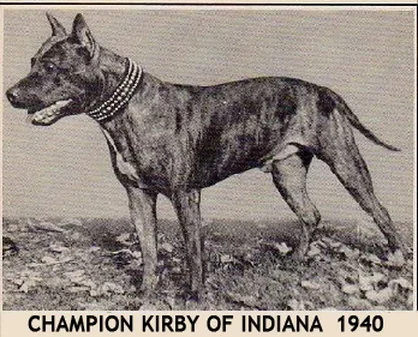
Kirby of Indiana was one of the earliest AKC Champion American Staffordshire Terrier. The breed was recognized by the AKC in 1936. Kirby of Indiana is an example of an early Amstaff Champion.
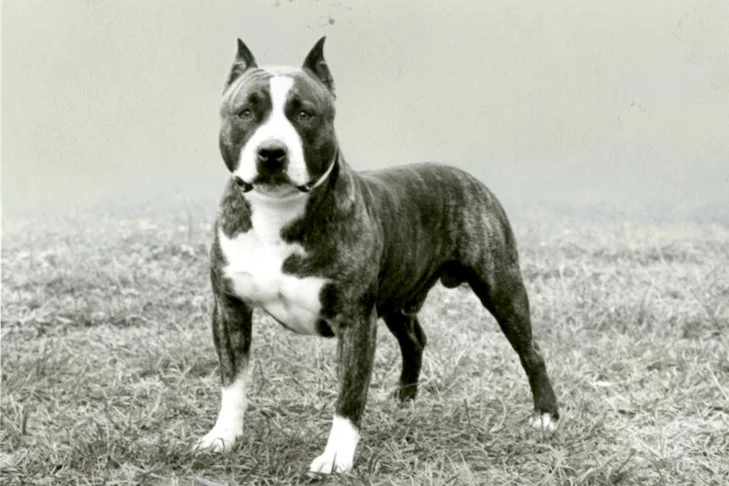
Ch. Rip Rick Irish Mike, American Staffordshire Terrier. c. 1958